
You’ve been told it’s your fault.
That if you just tried harder, ate less, exercised more, had more willpower—your PCOS would magically disappear. Your cycles would regulate. The weight would come off. Your skin would clear. Your energy would return.
But here’s what they don’t tell you: PCOS isn’t a willpower problem. It’s a biology problem.
And I’m here to unpack it with you.
Why I Started This
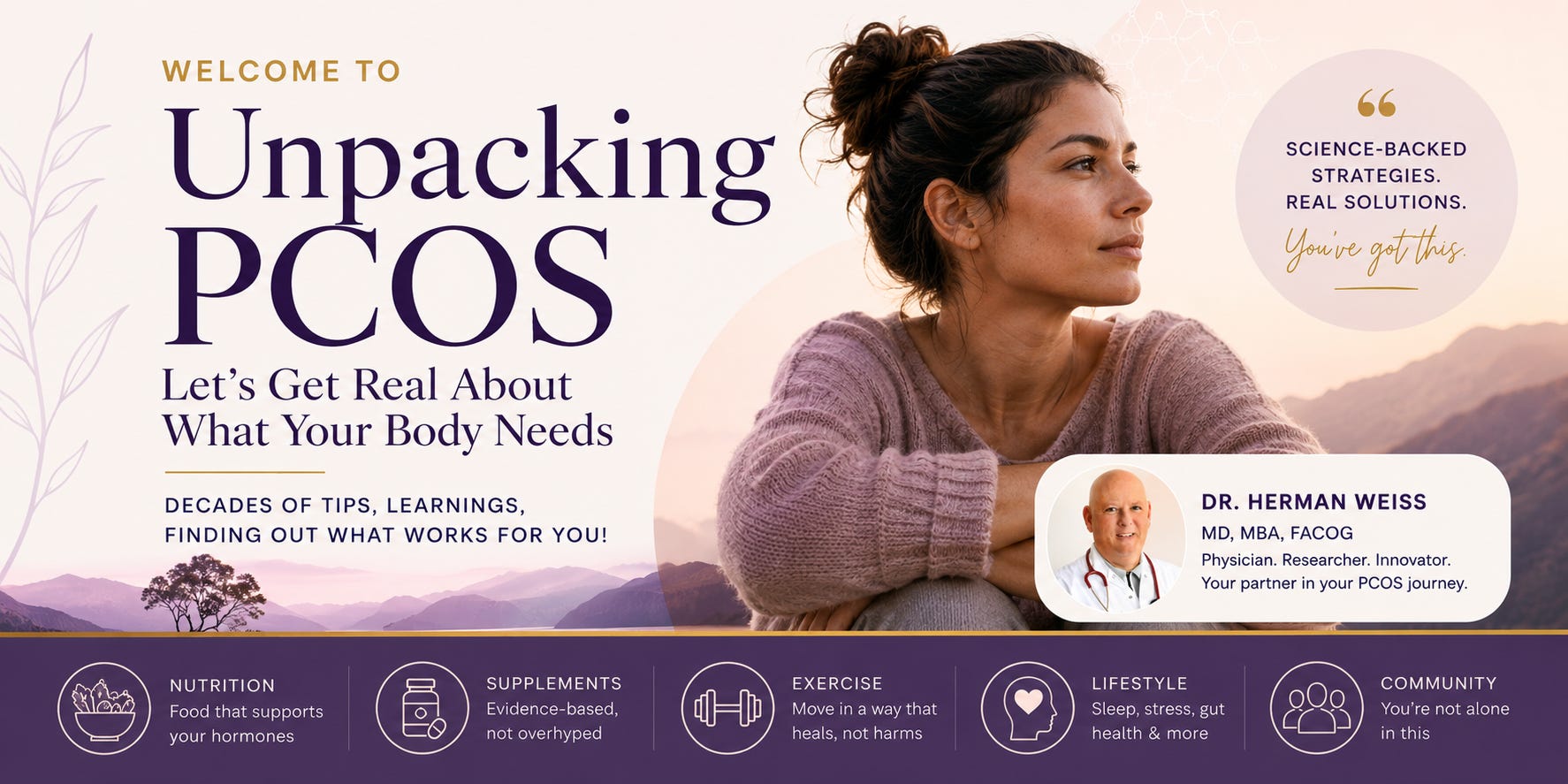
I’m Dr. Herman Weiss, and I’ve spent years watching intelligent, motivated women beat themselves up over a condition that was never their fault to begin with.
In my practice, I’ve seen women who’ve tried every diet imaginable—keto, paleo, vegan, Weight Watchers, intermittent fasting, calorie counting. They’ve purchased expensive supplements based on Instagram recommendations. They’ve worked out six days a week despite crushing fatigue. They’ve spent thousands on nutritionists, naturopaths, and wellness coaches.
And they’re still struggling.
Not because they’re doing something wrong, but because PCOS requires a fundamentally different approach than what mainstream health advice offers.
That’s why I created this Substack. To cut through the noise, debunk the myths, and give you the science-backed strategies that actually work for bodies like ours.
What Makes PCOS Different (And Why Generic Advice Fails)
Here’s the truth they don’t tell you in that rushed 15-minute doctor’s appointment:
Your body doesn’t process food the same way.
When someone without PCOS eats a bowl of pasta, their insulin response is predictable and controlled. When you eat that same bowl of pasta, your insulin can spike 2-3x higher and stay elevated longer. This isn’t about portion sizes or willpower—it’s about fundamental metabolic differences.
Your hormones are in a constant tug-of-war.
Elevated insulin drives testosterone production. High testosterone disrupts ovulation. Lack of ovulation means low progesterone. Low progesterone means estrogen dominance. It’s not one problem—it’s a cascade. And treating just one piece (like taking birth control to regulate periods) doesn’t fix the underlying dysfunction.
Your body is in a chronic inflammatory state.
That stubborn belly fat? Those painful periods? The brain fog and fatigue? It’s not just “stress” or “getting older.” It’s systemic inflammation driven by insulin resistance, gut dysfunction, and hormonal chaos.
This is why the advice that works for your friends doesn’t work for you.

What We’ll Unpack Together
Over the coming weeks and months, I’m going to take you deep into the science of PCOS—but in a way that’s actually useful. No complicated medical jargon. No vague “eat healthy and exercise” nonsense. Real, actionable strategies you can implement today.
🍽️ Nutrition That Actually Works
Forget calorie counting. We’re going to talk about:
Why high-protein, moderate-carb eating outperforms low-calorie diets for PCOS
The glycemic load concept and why it matters more than “good carbs vs. bad carbs”
How to structure your meals to prevent insulin spikes (hint: it’s not about eating less)
The hidden inflammatory foods sabotaging your progress (and no, it’s not just gluten and dairy)
Real meal examples and food swaps that satisfy you while supporting your hormones
Teaser: The breakfast you’re eating right now is probably triggering an insulin roller coaster that tanks your energy by 11am. I’ll show you how to fix it.
💊 Supplements: What Works, What’s Hype
The supplement industry is a minefield of false promises and Instagram influencers selling magic pills. Let’s get scientific:
Inositol: Why the dose everyone recommends (4,000mg) causes GI distress—and how low-dose formulations can be just as effective
Berberine vs. Metformin: The truth about “nature’s Metformin”
Omega-3s, Vitamin D, and Magnesium: Which forms actually work and which are a waste of money
The supplements you’re taking that might be making things worse
Teaser: There’s a patented inositol formulation that maintains effectiveness at a fraction of the standard dose. I’ll explain the science behind why less can actually be more.
🏋️ Exercise: Stop Punishing Your Body
Chronic cardio and HIIT workouts might be sabotaging your hormones, not helping them. We’ll explore:
Why overtraining worsens insulin resistance and cortisol dysregulation
Cycle-syncing your workouts: What to do during follicular vs. luteal phases
Strength training protocols that build muscle without triggering stress responses
How walking (yes, just walking) can be more effective than your Peloton obsession
Rest and recovery: Why doing less might get you better results
Teaser: If you’re exhausted after every workout and not seeing results, you’re likely in a chronic stress state that’s making your PCOS worse. There’s a better way.
🧠 Lifestyle Factors Everyone Ignores
PCOS isn’t just about food and exercise. Your body is a system, and everything affects everything:
Sleep: Why poor sleep destroys insulin sensitivity (and what to do about it)
Stress management: How cortisol drives the insulin-testosterone cascade
Gut health: The PCOS-gut connection no one talks about
Environmental toxins: Endocrine disruptors hiding in your skincare and household products
Community and support: Why isolation makes symptoms worse
What Makes This Different
I’m not here to sell you a 30-day challenge or a magic supplement protocol. I’m a physician who developed the first patented low-dose inositol formula specifically for PCOS. I’ve spent years in the research, the clinical work, and most importantly—listening to women who are tired of being dismissed.
This Substack is different because:
✅ Evidence-based, not trendy. Every recommendation is backed by peer-reviewed research, not Instagram anecdotes.
✅ Practical, not theoretical. I’ll give you meal plans, shopping lists, supplement protocols, and workout structures you can actually follow.
✅ Honest, not salesy. I’ll tell you when something is overhyped, overpriced, or just plain doesn’t work—even if it’s popular.
✅ Comprehensive, not one-dimensional. PCOS is complex, and the solution has to address nutrition, movement, stress, sleep, supplements, and community.
Join the Community
Here’s what I’m building:
Deep-dive educational content that explains not just what to do, but why it works. You’ll understand your body in a way no doctor has ever taken the time to explain.
Practical protocols and templates you can implement immediately. Meal plans, shopping lists, supplement guides, workout schedules.
Myth-busting the bad advice you’ve been following. We’ll call out the influencers, the fad diets, and the expensive “solutions” that don’t actually solve anything.
A community of women who get it. The comment section here will be a place to share experiences, ask questions, celebrate wins, and support each other through the hard days.
What’s Coming Next
In my next post, I’m breaking down the insulin-testosterone connection—the core dysfunction driving most PCOS symptoms. You’ll learn:
Why your body is stuck in “fat storage mode” even when you’re eating less
The exact mechanism that causes those stubborn cravings and energy crashes
How to interrupt this cycle (without starving yourself or living at the gym)
Then we’ll dive into:
Week 1: Building your PCOS-friendly plate (with actual meal examples)
Week 2: The supplement starter kit (what to take and when)
Week 3: Exercise that heals, not harms
Week 4: Stress, sleep, and the lifestyle factors that make or break your progress
Let’s Do This Together
If you’re tired of:
Conflicting advice from every corner of the internet
Doctors who dismiss your symptoms or just hand you birth control
Diets that work for everyone else but leave you exhausted and heavier
Feeling like your body is broken and there’s no way out
You’re in the right place.
PCOS is complex, but it’s not a mystery. It’s biology, and biology can be understood and optimized.
I’m going to show you how.
Hit subscribe, drop a comment below, and let me know:
How long have you been dealing with PCOS?
What’s the most frustrating part of your journey?
What do you wish someone had explained to you years ago?
Let’s unpack this together.
Welcome to the community. I’m glad you’re here.
— Dr. Herman Weiss
P.S. If this resonated, share it with another woman who’s struggling. PCOS affects 1 in 10 women, but most of us feel completely alone in dealing with it. Let’s change that.
Subscribe to get the next deep-dive on the insulin-testosterone connection delivered straight to your inbox. →