
By Dr. Herman Weiss, MD, MBA, FACOG · ProvationLife™ · Free to all subscribers · Series overview
The morning the announcement came through that Polycystic Ovarian Syndrome was being formally reframed as Polyendocrine Metabolic Ovarian Syndrome, my phone did not stop. Patients who had been fighting with pharmacists over metformin prescriptions. Women who had been told by other physicians that their PCOS was “getting better” as they approached perimenopause. Colleagues who had been quietly using insulin-first frameworks for years are finally seeing the field catch up.
I called it. I’ve been calling it for the better part of two decades in clinical practice. And I suspect many of you reading this called it too.
But here’s what I said then and what I’ll say again now: the name change is not the destination. It’s the starting line. Because naming a condition Polyendocrine Metabolic without then delivering on the clinical depth that name implies is just branding. The word polyendocrine is not a descriptor. It is a diagnostic mandate. It obligates us to understand, measure, and treat every endocrine axis implicated in this disease — not just the one that shows up on a standard panel, not just the one we happened to train on, and not just the one the supplement market has decided to capitalize on this month.
That is what this series is.
The ovary is not the villain in PMOS. It never was. The ovary is the last organ standing when everything upstream has failed it. It is the readout of a systemic metabolic and endocrine collapse. Our job has always been to read further upstream than the ultrasound.
— Dr. Herman Weiss, MD, MBA, FACOG
WHAT THIS SERIES IS — AND WHAT IT ISN’T
This is not a PMOS 101 series. If you are looking for a beginner’s guide to polycystic ovary symptoms and lifestyle tips, there are hundreds of those online, and most of them say more or less the same thing. This is not that.
This is a physician-level, evidence-grounded, intellectually honest deep dive into the endocrine architecture of PMOS. Each installment covers one of the seven major hormonal axes implicated in this disease. Each installment does three things: it maps the basic science with the precision it deserves; it translates that science into specific, actionable clinical practice; and it provides an honest, referenced review of the pharmacological and supplement landscape, telling you what the evidence actually supports, what it does not support, and in some cases what is actively contraindicated in this population despite being heavily marketed.
The series is written for clinicians, advanced practitioners, and for the increasingly scientifically sophisticated patients who have spent years researching their own condition and deserve to be given the real information. It is also written for anyone who has ever sat in an exam room with a woman who has been dismissed, undertreated, or given a supplement stack with no mechanistic grounding and wondered: What does she actually need to know?

Every claim is referenced. Every supplement recommendation is graded. Every pharmaceutical recommendation is grounded in the current evidence hierarchy. I will tell you when the evidence is strong, when it is preliminary, and when the wellness market has outrun the science by three or four decades. I will not soften findings in either direction.
THE SEVEN-PART ROADMAP
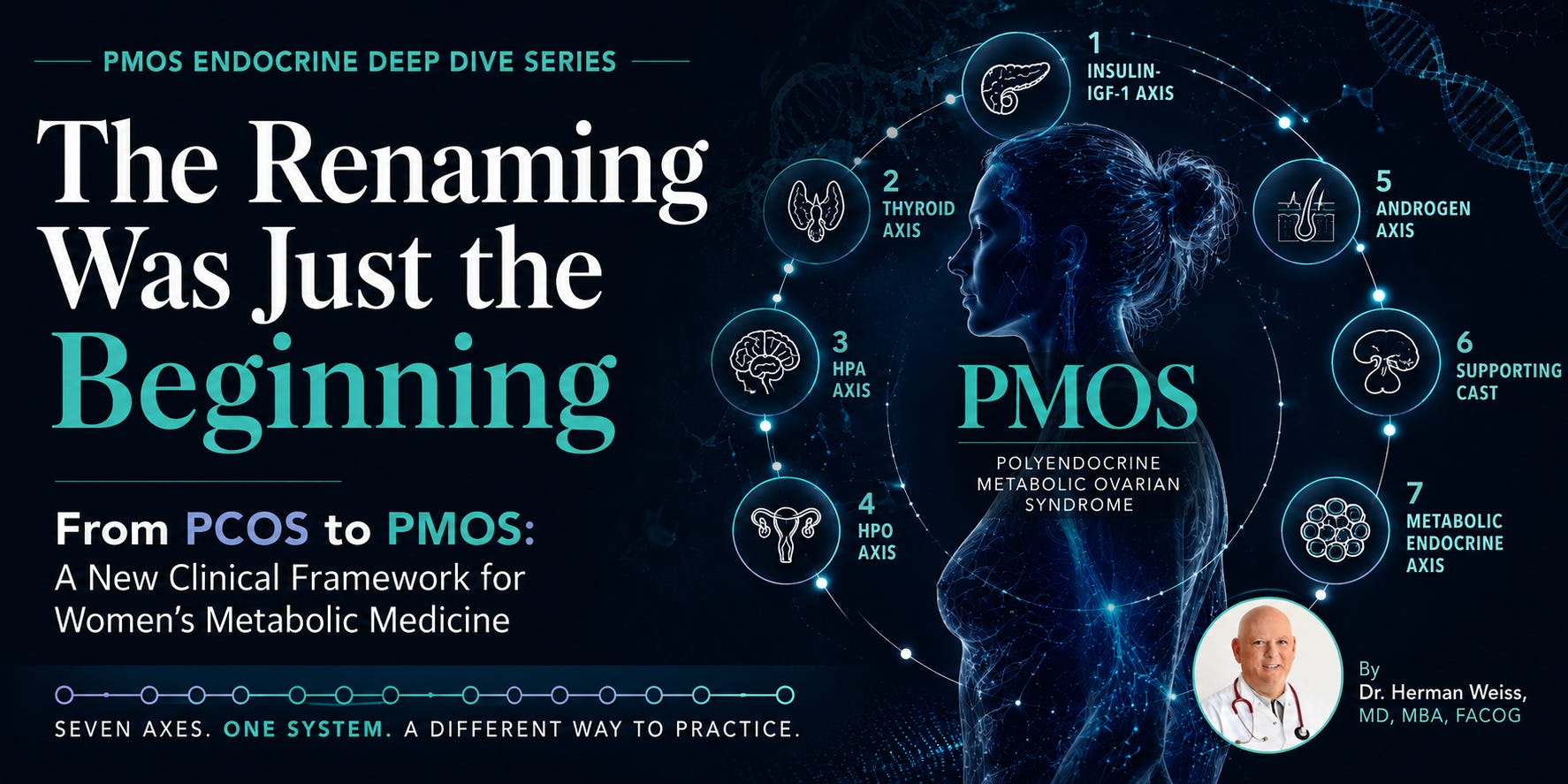
Here is where we are going. Seven installments. Seven endocrine axes. One complete clinical framework.
What You Will Learn
1. Insulin-IGF-1 Axis
The engine room of PMOS. Why hyperinsulinemia drives every downstream feature of this disease. How to measure it correctly. What actually works — from metformin to myo-inositol to GLP-1 agonists.
2. Thyroid Axis
Why Hashimoto’s thyroiditis appears in 1 in 4 PMOS patients. The T3 controversy and where it crosses the line from clinical nuance to supplement industry exploitation. What selenium, iodine, and Vitamin D actually do.
3. HPA Axis
Cortisol, DHEA-S, and the adrenal androgen phenotype. The “adrenal fatigue” diagnosis that doesn’t exist — and the HPA dysregulation that does. Why sleep is endocrine medicine. What ashwagandha can and cannot do.
4. HPO Axis
The GnRH pulse frequency story. Why the LH:FSH ratio is both useful and misunderstood. The AMH-hypothalamus connection that is rewriting PMOS pathophysiology. Letrozole vs. clomiphene: what the NEJM said and why it changed practice.
5. Androgen Axis
Why total testosterone is an inadequate measure. SHBG as a metabolic biomarker. The 5α-reductase story and why DHT is the tissue villain. Hirsutism, AGA, acne — clinical scoring, treatment hierarchy, and the progestin selection problem nobody talks about enough.
6. Supporting Cast
Prolactin: the confounder, the comorbidity, and the PEG precipitation test that prevents unnecessary MRI. Growth hormone in PMOS. Vitamin D as a steroid hormone. The T3/reverse T3 story in chronic metabolic stress. Vitex agnus-castus: the one supplement with a credible prolactin mechanism.
7. Metabolic Endocrine Axis
Adipokines, leptin resistance, adiponectin, the gut-hormone interface. The GLP-1 revolution and what it means for PMOS specifically. MASLD in PMOS. The cardiovascular risk data we should be quoting at every encounter. The complete series synthesis: one patient, seven axes, one coherent clinical logic.
A CLOSER LOOK AT WHAT’S COMING
Here is a preview of each installment, the clinical questions each one will answer, and why they matter.
PART ONE · The Insulin-IGF-1 Axis: The Engine Room
This is the most important installment in the series because it addresses the most important pathophysiological truth in PMOS: insulin resistance is not a comorbidity. It is not a feature. It is the central generative architecture from which every other endocrine and reproductive dysfunction in this disease cascades. Understanding why requires understanding a molecular paradox — one that took decades of research to characterize and that fundamentally explains why this condition has been so persistently mismanaged.
▸ Why can a woman with a fasting glucose of 88 still be producing massive androgen excess through hyperinsulinemia?
▸ What is the serine kinase defect that simultaneously drives insulin resistance AND upregulates androgen synthesis — from the same molecular lesion?
▸ What does HOMA-IR actually measure and why is it not enough?
▸ Why is myo-inositol deficiency in PMOS not an accident — it is mechanistically predicted by the disease itself?
▸ Berberine, NAC, alpha-lipoic acid, inositol, metformin: what does each one actually do, and which has the evidence to justify the price tag?
PART TWO · The Thyroid Axis: Comorbidity, Amplifier, Diagnostic Trap
One in four PMOS patients has Hashimoto’s thyroiditis. That is not an anecdote. It is a meta-analyzed prevalence figure with odds ratios ranging from 2 to 4 depending on the population studied. And yet routine PMOS workups frequently omit anti-TPO antibodies. Part Two will change how you order and interpret thyroid labs in every PMOS patient you see — and deliver the most honest review of the thyroid supplement market you will find anywhere.
▸ Why does hypothyroidism lower SHBG, worsen hyperandrogenism, and deepen anovulation — even when the TSH is technically “normal”?
▸ The T3/reverse T3 debate: where legitimate clinical nuance ends and supplement industry exploitation begins
▸ Selenium: the one thyroid supplement with genuine RCT evidence — and the exact dose and formulation that matters
▸ High-dose iodine in a patient with Hashimoto’s: why this is not a harmless supplement but an active contraindication
▸ The myo-inositol + selenium combination: why it works on the thyroid and the ovary simultaneously
PART THREE · The HPA Axis: Stress, Cortisol, and the Adrenal PMOS Phenotype
The HPA axis chapter is the one that requires the most intellectual discipline, because the wellness industry has built an entire universe around cortisol dysregulation that is simultaneously partially correct and substantively distorted. “Adrenal fatigue” does not exist as a medical diagnosis. HPA axis dysregulation very much does. Part Three will teach you to tell the difference clinically, biochemically, and pharmacologically.
▸ What does adrenal androgen hyperresponsiveness look like on a lab panel, and which 20–35% of PMOS patients have it as their primary driver?
▸ The 11β-HSD1 enzyme in visceral fat: why serum cortisol can be normal while tissue cortisol is pathologically elevated
▸ Non-classical congenital adrenal hyperplasia: the diagnosis hiding in 1–2% of PMOS presentations that is entirely treatable and routinely missed
▸ Sleep apnea in PMOS: the undiagnosed condition that is simultaneously wrecking insulin sensitivity, cortisol rhythm, GH pulsatility, and reproductive function
▸ Ashwagandha KSM-66, phosphatidylserine, magnesium: what the randomized trial evidence actually say
PART FOUR · The HPO Axis: The Architecture of Anovulation
Part Four arrives at the axis everyone thinks of first when they hear the word “ovary” — and will immediately reframe it. The HPO axis in PMOS is not the source of the disease. It is the anatomical site where the disease becomes clinically visible. Understanding the GnRH pulse frequency story, the AMH-hypothalamus feedback loop, and why the progesterone brake is chronically disengaged is the foundation of rational fertility treatment in this condition.
▸ Why do the follicles arrest at 4–9 mm? What are they waiting for that they will never receive in an uncorrected PMOS environment?
▸ The 2023 Nature-lineage discovery: how elevated AMH from the arrested follicle pool feeds back to the hypothalamus and drives GnRH hypersecretion — making the ovary a co-driver of its own dysfunction
▸ Letrozole vs. clomiphene: the PPCOS II NEJM trial, the live birth rate difference, and why the mechanism explains the result
▸ The perimenopausal PMOS patient who is told she’s improving: why this is one of the most dangerous misunderstandings in women’s health
▸ Why AMH measurement has largely supplanted antral follicle count, and how to use it as a therapeutic monitoring tool
PART FIVE · The Androgen Axis: Where the Hormonal Excess Meets the Patient
This is the installment that most directly addresses what the patient sees and experiences every day. Hirsutism. Acne. Hair thinning. The features that drive women to seek diagnosis in the first place, that carry the greatest psychological burden, and that are most frequently addressed with cosmetic interventions while the metabolic driver continues running unchecked. Part Five will give you the tools to measure androgen status correctly, treat it mechanistically, and counsel your patients on a supplement market that ranges from evidence-based to dangerous.
▸ Why a woman with a “normal” total testosterone can have clinically severe hyperandrogenism — and what SHBG reveals that total testosterone does not
▸ The 5α-reductase paradox: why the same enzyme that drives facial hair growth causes scalp hair loss, and why DHT is the tissue villain serum testosterone can never fully expose
▸ Androgenic alopecia in PMOS: why the treatment window closes permanently, why we miss it systematically, and the four-pillar management framework that actually addresses the cause
▸ The progestin selection problem: why prescribing levonorgestrel-based contraception in a hyperandrogenic PMOS patient is a clinical mismatch
▸ Spearmint tea: a casual wellness remedy or a compound with documented androgen receptor binding activity and two RCTs? The honest answer is more interesting than either extreme.
PART SIX · The Supporting Cast: Prolactin, Growth Hormone, Vitamin D, and the Secondary Axes
Part Six covers the hormones that do not headline the PMOS story but that account for a disproportionate share of the cases that do not respond as expected to standard management. Prolactin is the most common endocrine confounder of the HPO axis — and is routinely measured incorrectly, with results that trigger unnecessary MRI workups in women whose prolactin is physiologically normal. Vitamin D is a steroid hormone whose receptor is expressed in the pancreas, the ovary, the thyroid, the adrenal gland, and the immune system simultaneously. Missing either changes the clinical trajectory.
▸ The pre-analytical protocol for prolactin measurement that your laboratory requisition form does not include — and why it prevents unnecessary pituitary imaging
▸ Macroprolactinemia: the biologically inactive immune complex that immunoassay cannot distinguish from pathological hyperprolactinemia without one simple laboratory step
▸ Why Vitamin D deficiency in PMOS is not explained by sun exposure alone — and why repleting it without magnesium co-administration may produce a blunted response
▸ The T3/reverse T3 story in caloric restriction and metabolic stress: when is it clinically meaningful, when is it a wellness industry narrative, and how do you tell the difference?
▸ Vitex agnus-castus: the mechanistic case for its dopamine D2 agonist activity, the eight RCTs that support it, and the precise clinical phenotype where it belongs
PART SEVEN · The Metabolic Endocrine Axis: Adipokines, Gut Hormones, and the Frontier
The final installment closes the series with the endocrine biology of adipose tissue itself — and with the pharmacological revolution it has generated. Adipose tissue in PMOS is not a passive fat depot. It is a dysfunctional endocrine organ secreting an altered cytokine and hormone profile that perpetuates insulin resistance, suppresses the HPO axis, and accelerates cardiovascular risk simultaneously. And the drugs targeting this system — GLP-1 receptor agonists — represent the most significant therapeutic advance in PMOS since metformin was introduced. Part Seven will tell you exactly what the evidence supports, what it does not, and how to synthesize seven installments of endocrine architecture into a single coherent clinical approach for every PMOS patient you see.
▸ Why adiponectin is the adipokine that predicts T2DM progression better than fasting glucose in PMOS cohorts — and what actually raises it
▸ The GLP-1 deficit in PMOS: why women with this condition produce less incretin response to meals, what that means for the postprandial insulin cycle, and why GLP-1 agonists are not just weight loss drugs in this population
▸ Semaglutide vs. metformin head-to-head in PMOS: the 2023 RCT data, the live-birth rate difference, the lean mass loss problem, and what the evidence actually says about sequencing
▸ MASLD in PMOS: prevalence, the transaminase screening failure, and why semaglutide is now the most evidence-supported pharmacological intervention for hepatic steatohepatitis in this population
▸ The complete synthesis: one master clinical table across all seven axes axis, primary driver, key labs, first-line pharmacotherapy, first-line supplement the clinical framework that takes everything in this series and makes it immediately usable
WHO THIS IS FOR
This series is written for:
Physicians and advanced practice clinicians managing PMOS in any specialty — OB/GYN, endocrinology, internal medicine, family medicine, reproductive endocrinology. The mechanisms are universal. The clinical applications are immediate.
Registered dietitians, health coaches, and allied health professionals who work with PMOS patients and want a mechanistic foundation for the nutritional and supplement recommendations they make. If you are going to recommend inositol or berberine or selenium, you should understand exactly why at the molecular level.
The well-researched patient who has spent years in forums, Facebook groups, and medical databases trying to understand why the standard “just lose weight and take the pill” advice has never fully addressed her disease. You deserve the same information your physicians have access to — and in some cases, more of it than they were given in training.
Anyone who has ever looked at a PMOS management plan that stops at cycle regulation and fertility and wondered: what about the cardiovascular risk? What about the insulin resistance that will still be there at 60? What about the endometrium? What about the patient in the perimenopausal transition who is being told she is getting better when she is entering her highest-risk metabolic decade?
A NOTE ON THE SUPPLEMENT REVIEWS
Each installment in this series includes a structured review of the supplement and nutraceutical landscape relevant to that axis. I want to be clear about the editorial standard I am holding myself to in these reviews, because it is different from what you will find in most wellness content and in most physician content:
I will not dismiss what the evidence supports because it comes from a supplement bottle rather than a pharmaceutical manufacturer. Myo-inositol has multiple randomized controlled trials showing clinical equivalence to metformin in specific endpoints. Selenium has a Cochrane-adjacent systematic review supporting its use in Hashimoto’s thyroiditis. These are not anecdotes. They are data, and they deserve to be treated as data.
I will not endorse what the evidence does not support because a product is popular, well-marketed, or intuitively appealing. High-dose iodine in a Hashimoto’s patient is contraindicated. DHEA supplementation in a hyperandrogenic PMOS patient is predictably harmful endocrine pharmacology. “Adrenal fatigue” protocols are not supported by the medical literature regardless of how passionately their advocates present them.
Every supplement will receive an evidence grade (A through D) with explicit rationale. The grade is based on the quality, quantity, and replicability of human clinical data — not on mechanistic plausibility alone, not on marketing materials, and not on patient testimonials.
The supplement market targeting PMOS is worth billions of dollars annually. Some of that money goes toward products with genuine clinical rationale. Much of it does not. Our patients deserve to know which is which.
THE PERSONAL DIMENSION
I have been practicing obstetrics and gynecology for 25 years. I have been managing PMOS with an insulin-first metabolic framework for most of that time — long before the name change made that framework official. And in those 25 years, I have watched this disease accumulate its consequences in women who were not given the tools to understand what was happening in their own bodies.
The woman who was told at 24 that she just needed to lose weight and come back when she wanted to get pregnant. The woman at 38 who arrived with a fatty liver, pre-diabetes, and androgenic alopecia that had been progressing for a decade while she was prescribed different formulations of the pill. The woman at 52 who was told her PCOS was “getting better” as her cycles regularized in perimenopause — and who six years later had a cardiovascular event that a metabolic risk profile from her thirties could have predicted.
These are not cautionary tales I invented. They are clinical realities I have witnessed repeatedly over a career in women’s medicine. And they are preventable — not entirely, not in every case, but overwhelmingly — when we bring the full endocrine architecture of this disease to bear on management from the moment of diagnosis.
PMOS is finally named correctly. The word polyendocrine is finally in the title. Now the clinical practice has to earn that title. This series is my contribution to that project.
The name change is not the destination. It’s the obligation. Naming this disease polyendocrine metabolic means we are now accountable to practicing it that way.
— Dr. Herman Weiss, MD, MBA, FACOG
HOW TO READ THIS SERIES
Each installment is designed to stand alone. If you come to this series at Part Four, you will not be lost. But the series is also designed as a cumulative architecture: each installment builds on the mechanisms established in the previous ones, and by the time you reach Part Seven, the clinical synthesis will be visible in a way it cannot be from any single installment alone.
Each installment will follow a consistent structure: the foundational biology, the clinical implications, the laboratory assessment framework, and the supplement/pharmacological review. The tone throughout will be what I hope characterizes everything I write and say on this platform: informed, direct, and honest about uncertainty. I will not pretend to know more than the evidence supports. I will not retreat from what the evidence clearly shows because it is inconvenient for a popular narrative.
Premium subscribers will receive each installment in full as both a Substack article and a formatted clinical reference document, printable, annotated, and organized for direct use in practice or for sharing with patients.
The PMOS Endocrine Deep Dive Series — Release Schedule
Part 1: The Insulin-IGF-1 Axis — The Engine Room
Part 2: The Thyroid Axis — Comorbidity, Amplifier, Diagnostic Trap
Part 3: The HPA Axis — Cortisol, DHEA-S, and the Adrenal PMOS Phenotype
Part 4: The HPO Axis — The Architecture of Anovulation
Part 5: The Androgen Axis — Where the Hormonal Excess Meets the Patient
Part 6: The Supporting Cast — Prolactin, Growth Hormone, Vitamin D, and the Secondary Axes
Part 7: The Metabolic Endocrine Axis — Adipokines, Gut Hormones, and the Complete Series Synthesis
All parts are available now for Premium subscribers.
Share this introduction with anyone who has been told their PCOS is “just a reproductive issue.” It is not. It never was.
Let’s get to work.
— Dr. Herman Weiss, MD, MBA, FACOG
Founder and CEO, ProvationLife™ · Host, The Metabolic Fix
If this resonates, share it. The woman who has been told her PCOS isn’t that serious needs to read this. The physician who has never ordered an anti-TPO antibody in a PCOS patient needs to read this. The dietitian who has been recommending high-dose iodine for thyroid support in PMOS patients needs to read this. The series is free to share. · @hweissmd
ProvationLife™ · The Metabolic Fix · @hweissmd · PMOS Endocrine Series — Introduction