
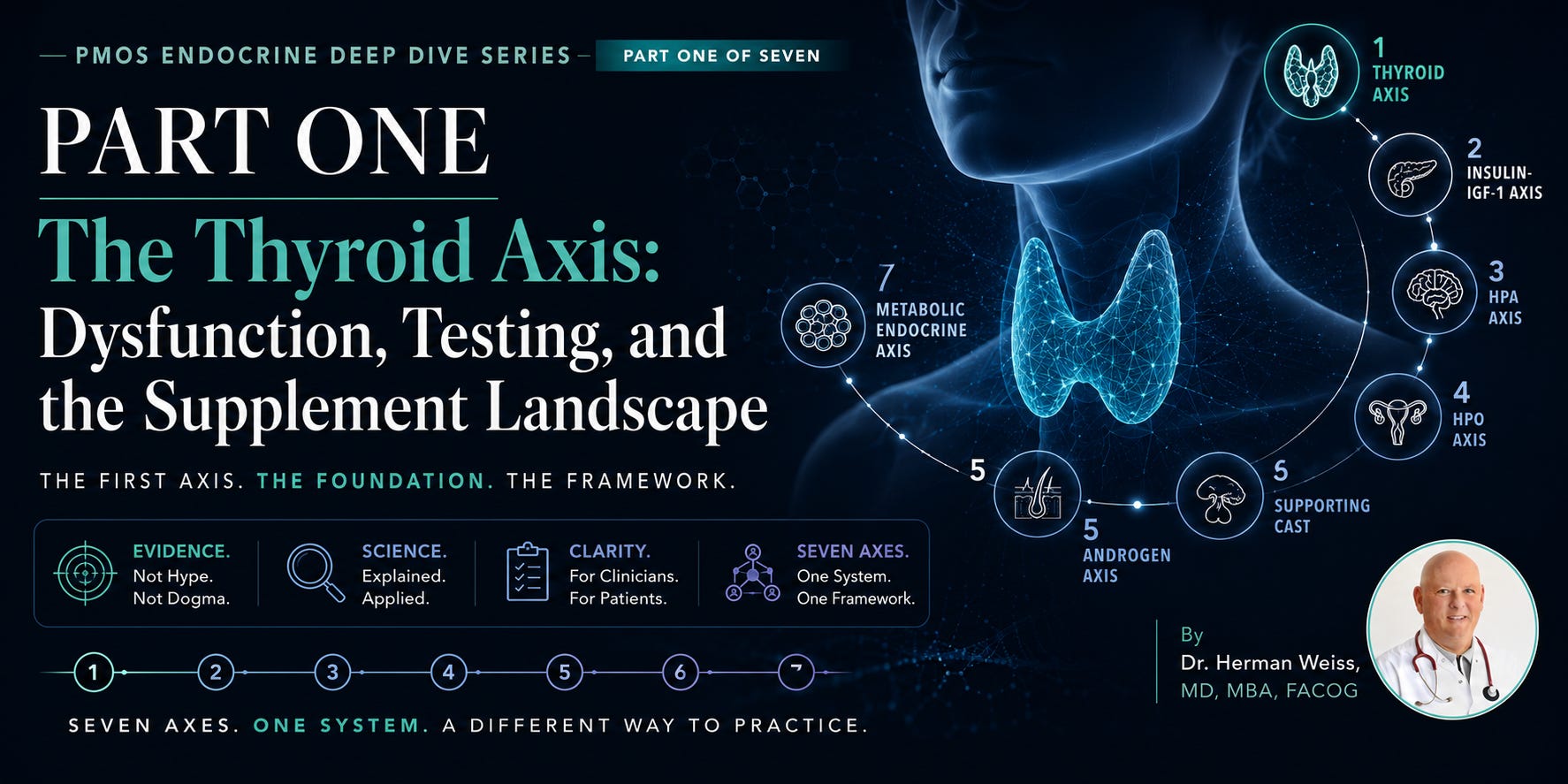
The renaming of PCOS to Polyendocrine Metabolic Ovarian Syndrome is not a cosmetic change. It is a structural one. It forces us physicians, patients, and the medical establishment alike — to look at this condition through a fundamentally different lens. The word polyendocrine is not decorative. It is a diagnostic mandate.
In the old frame, we treated the ovary as the source. In the new and correct frame, we treat the ovary as the destination, the end organ that bears the consequences of a systemic endocrine and metabolic environment that has been dysregulated, often for years, sometimes for decades, before a diagnosis is made.
This series will take each of those endocrine systems in turn, examine the science with specificity and honesty, and, where relevant, assess the evidence, including the supplement market, which is increasingly crowded and often inadequately grounded. We will not validate what is not supported. We will also not dismiss what the data shows, even when it challenges received wisdom.
The Seven Endocrine Axes in PMOS, A Series Roadmap
Part 1 (This Article): Thyroid — Dysfunction, Testing, and the Supplement Landscape
Part 2: The Insulin-IGF-1 Axis — Hyperinsulinemia as the Central Driver
Part 3: The HPA Axis — Cortisol, Adrenal Androgens, and DHEA-S in PMOS
Part 4: The HPO Axis — LH/FSH Dysregulation and the GnRH Pulse Problem
Part 5: Androgens — Testosterone, SHBG, and the Tissue-Level Story
Part 6: Prolactin, Growth Hormone, and the Supporting Cast
Part 7: The Metabolic Endocrine Axis — Adipokines, Leptin, Adiponectin, and the Fat-Hormone Interface
Each installment will follow the same architecture: the basic science, the clinical implications, a frank evidence assessment, and, where applicable, an honest review of the supplement and nutraceutical landscape that has grown up around each axis. The goal is not to be reflexively skeptical of supplements, nor reflexively credulous. The goal is to give you the science, read it straight, and let it speak.
Now. Let us begin with the thyroid.
PART ONE
The Thyroid and PMOS: What We Know, What We Oversell, and What We Must Not Miss
1. The Thyroid-PMOS Connection Is Real, And Bidirectional
Let me be direct from the outset: the relationship between thyroid dysfunction and PMOS is not a supplement industry invention. It is a documented, peer-reviewed, clinically significant comorbidity with mechanistic plausibility running in both directions. The thyroid does not cause PMOS in the same way insulin resistance does. But thyroid dysfunction, particularly subclinical and overt hypothyroidism, mimics, amplifies, and masks PMOS in ways that carry real clinical consequences if missed.
A 2015 systematic review by Janssen et al., published in Human Reproduction Update, found that women with PCOS had a significantly higher prevalence of thyroid autoimmunity, particularly Hashimoto’s thyroiditis, compared to age- and BMI-matched controls — with odds ratios ranging from 2.07 to 4.0 depending on the population studied.¹ A subsequent meta-analysis by Sinha et al. (2013) reported thyroid peroxidase antibody (TPO-Ab) positivity in approximately 26–27% of PCOS patients compared to 8–10% of controls.²
These are not trivial numbers. They are asking us to check thyroid autoimmunity in every PMOS patient, not as an afterthought, but as part of the primary workup.
Why Thyroid Dysfunction Mimics and Amplifies PMOS
Hypothyroidism, overt or subclinical, does the following, each of which overlaps directly with the PMOS phenotype:
▸ Increases TRH (thyrotropin-releasing hormone), which stimulates prolactin secretion, which in turn suppresses GnRH pulsatility and disrupts the HPO axis, producing menstrual irregularity and anovulation³
▸ Reduces SHBG (sex hormone-binding globulin) synthesis in the liver, thereby increasing free androgen bioavailability — amplifying hyperandrogenism even without a primary increase in androgen production⁴
▸ Impairs glucose metabolism and worsens insulin resistance through reduced GLUT4 expression and impaired insulin receptor signaling — compounding the metabolic core of PMOS⁵
▸ Promotes dyslipidemia elevated LDL, reduced HDL which synergizes with the inherent cardiovascular risk in PMOS⁶
▸ Contributes to weight gain and reduced resting metabolic rate, creating a cycle that feeds back into insulin resistance and visceral adiposity
This is not a parallel pathway. This is the same metabolic and hormonal terrain. A woman with both subclinical hypothyroidism and PMOS is not dealing with two separate conditions. She is dealing with one amplified condition with two contributing axes.
2. The Testing Question: Where Standard of Care Ends and Controversy Begins
Here is where the clinical picture becomes more complicated, and where I will not pretend the medical community speaks with one voice. Because it does not.
What We Agree On: TSH Screening
The American Thyroid Association (ATA) and the Endocrine Society both support TSH screening as the initial test of choice for thyroid dysfunction. A TSH above 4.0–4.5 mIU/L (laboratory-dependent) with a low free T4 constitutes overt hypothyroidism and warrants treatment. This is unambiguous.⁷ Every PMOS patient should have a TSH measured at baseline. This is not controversial. What is controversial is what we do next.
Subclinical Hypothyroidism: The Gray Zone
Subclinical hypothyroidism (SCH), defined as a TSH of 4.0–10 mIU/L with a normal free T4, affects approximately 10% of women of reproductive age. In PMOS populations, that prevalence appears higher. The question of whether to treat SCH is genuinely debated in the endocrinology literature, and I want to present that debate honestly.
The 2019 ATA guidelines do not mandate treatment for SCH in non-pregnant women with TSH below 7.0 mIU/L unless there are specific indications (symptoms, cardiovascular risk, TPO-Ab positivity, fertility concerns).⁸ The 2023 European Thyroid Association guidelines are similarly conservative.⁹ This reflects the reality that most SCH normalizes spontaneously or does not progress to overt hypothyroidism, and randomized controlled trials have not shown consistent benefit from levothyroxine for SCH with TSH < 7.0 in otherwise healthy women.¹⁰
However, and this is critical, the PMOS patient is not an “otherwise healthy woman” in the context of this debate. She has pre-existing insulin resistance, dyslipidemia, androgen excess, and often HPO axis dysregulation. In this context, even a modest increase in TSH may have additive metabolic consequences that a standard population study would not capture. This is a legitimate clinical nuance, not a rationalization.

The T3 Controversy: Where Thyroid Advocacy Runs Ahead of Evidence
I want to address this directly because it is a source of significant confusion for patients, and, frankly, for some clinicians, and the supplement and functional medicine industries have exploited this confusion aggressively.
Free T3 (triiodothyronine) is the biologically active thyroid hormone. T4 (levothyroxine) is a prohormone that must be converted to T3 peripherally by deiodinase enzymes. A subset of patients on standard levothyroxine therapy continue to have symptoms despite normalized TSH, a phenomenon real enough to have generated a literature of its own. Bianco et al. have written extensively on impaired T4-to-T3 conversion as a clinically meaningful entity in some patients, potentially explained by polymorphisms in the DIO2 gene (deiodinase type 2).¹¹
However, and this is where I must be unambiguous, the routine measurement of free T3 as a screening tool in PMOS is not supported by evidence-based guidelines. The ATA does not recommend it as a first-line test. The Endocrine Society does not recommend it. The rationale for T3 measurement in PMOS patients is mechanistically plausible but clinically unvalidated at the population level.¹²
What this means in practice: if you have a PMOS patient with normalized TSH, persistent symptoms, and documented DIO2 polymorphism, a conversation about T3 measurement and combination T4/T3 therapy is legitimate. If you are ordering free T3 on every PMOS patient because a thyroid advocate told you to, you are operating outside the evidence base.
Clinical Testing Recommendations for Thyroid in PMOS — Evidence-Based
✓ TSH: Screen all PMOS patients at baseline. Repeat annually or with symptom change.
✓ Free T4: Order with abnormal TSH (high or low) to classify thyroid status.
✓ TPO Antibodies (anti-TPO): Order in all PMOS patients regardless of TSH autoimmunity changes in clinical trajectory.
✓ Thyroglobulin Antibodies (anti-Tg): Order when anti-TPO is negative but clinical suspicion remains.
△ Free T3: Consider in levothyroxine-treated patients with persistent symptoms and normal TSH. Not a routine screen.
△ Reverse T3: Insufficient evidence to support routine measurement in PMOS. Use selectively and interpret with caution.
✗ Full thyroid panel with RT3 + total T3 + T4 as routine PMOS workup: Not evidence-based at population level.
The Thyroid Supplement Landscape: An Honest Physician’s Review
The thyroid supplement market is one of the most crowded, most lucrative, and most scientifically uneven spaces in nutraceuticals. Estimated at over $1.2 billion annually in the United States, it sits at the intersection of legitimate science, patient frustration with standard care, and aggressive marketing that frequently outpaces the evidence.
I want to do something that is rare in this space: give each major ingredient a genuinely honest grade, not a dismissive “there’s no evidence” (when there is some), and not an enthusiastic endorsement that inflates the data beyond what it supports. Here is my evidence-based review of the most common thyroid-targeted supplements.
Supplement
Claimed Benefit
Evidence Grade
Clinical Reality
Selenium
Reduce TPO-Ab, support T4→T3 conversion
B+
Strongest thyroid supplement evidence. 200 mcg/day reduces TPO-Ab in Hashimoto’s. Clinically meaningful and low risk.
Iodine (high-dose)
Treat “iodine deficiency hypothyroidism”
C−
Excess iodine worsens autoimmune thyroid disease. High-dose supplementation is contraindicated in Hashimoto’s. Widely oversold.
Myo-Inositol + Selenium
Reduce TSH in subclinical hypothyroidism
B
Two RCTs show TSH reduction in SCH. Mechanistically relevant to PMOS given inositol’s insulin-sensitizing role.
Zinc
Support deiodinase enzyme function
C+
Deficiency impairs T4→T3 conversion. Repletion in deficient patients reasonable. Routine supplementation unvalidated.
Ashwagandha (KSM-66)
Normalize TSH and T4 via HPA modulation
B−
One RCT (Sharma 2018) showed TSH and T4 improvement in SCH. Promising but limited data. Cortisol effect may be mediating factor.
Magnesium
Reduce thyroid autoimmunity via anti-inflammatory effect
C+
Low magnesium is associated with higher TPO-Ab. Repletion sensible. Causality unproven.
Vitamin D
Reduce autoimmunity, modulate Treg/Th17 balance
B
Inverse association between vitamin D and TPO-Ab is robust. RCT data mixed but biological plausibility strong. Repletion in deficient PMOS patients is justified.
B12
“Energy and thyroid support”
D
No direct thyroid mechanism. Often added to formulas as a “feel better” ingredient. Relevant only in documented deficiency.
Desiccated Thyroid (NDT)
Full T4 + T3 replacement from porcine source
B−
Contains T3 + T4 in 4:1 ratio (not physiological 20:1). Reduces rT3 in some patients. Evidence inferior to levothyroxine for most patients but legitimate for T3 non-converters. Not a supplement — a prescription medication.
Bladderwrack / Kelp
“Natural iodine” for thyroid
D−
Uncontrolled iodine delivery. Risk of triggering Wolff-Chaikoff effect. Contraindicated in Hashimoto’s. No therapeutic role.
Tyrosine (L-Tyrosine)
Thyroid hormone precursor support
D
Thyroid hormone synthesis is not rate-limited by tyrosine in replete individuals. Theoretical rationale only.
Guggul (Commiphora mukul)
Increase T3 via guggulsterone activity
C
Animal data intriguing. Human RCT data sparse and mixed. Cannot recommend in PMOS currently.
Selenium: The One Thyroid Supplement With Genuine Evidence
Selenium deserves its own section because it is the single most evidence-supported thyroid supplement in the clinical literature, and it happens to be directly relevant to the PMOS population. Selenium is an essential component of the selenoprotein family, which includes glutathione peroxidases, thioredoxin reductases, and — critically — the deiodinase enzymes responsible for T4-to-T3 conversion.
Ventura et al. (2017) conducted a double-blind RCT of 200 mcg/day selenomethionine in 68 Hashimoto’s patients, demonstrating a significant reduction in TPO-Ab (from 1289 ± 212 to 643 ± 165 IU/mL, p < 0.001) and improved thyroid ultrasound echogenicity.¹³ A Cochrane-adjacent systematic review by Wichman et al. (2016) of four RCTs found consistent TPO-Ab reduction with selenomethionine at 200 mcg/day.¹⁴
The mechanism is immunomodulatory: selenium reduces reactive oxygen species in thyroid tissue, which is particularly significant in autoimmune thyroid disease where H₂O₂-mediated oxidative damage drives the inflammatory cascade. In PMOS patients with documented Hashimoto’s thyroiditis, selenium supplementation at 200 mcg/day has a legitimate clinical rationale and a reasonable evidence base.
Important caveat: Selenium toxicity (selenosis) occurs above 400 mcg/day and is a real clinical concern. Supplementation above 200 mcg/day is not supported by additional benefit and increases risk. Food sources: Brazil nuts, tuna, and sardines are adequate for selenium-replete individuals and should be considered first. Routine supplementation in selenium-replete populations without autoimmune thyroid disease is not justified by the evidence.
Iodine: The Supplement Most Likely to Harm Your PMOS Patient
I will say this plainly: high-dose iodine supplementation, particularly the multi-milligram doses marketed in certain “thyroid support” and “iodine loading” protocols, is contraindicated in patients with Hashimoto’s thyroiditis and should be approached with extreme caution in PMOS patients generally.
The Wolff-Chaikoff effect, the transient suppression of thyroid hormone synthesis in response to excess iodine, is a physiological protective mechanism. In individuals with underlying thyroid autoimmunity, this effect may not be transient. Excess iodine increases thyroid peroxidase activity and hydrogen peroxide generation, increasing oxidative damage and stimulating inflammatory cascades in autoimmune thyroid tissue.¹⁵
Leung et al. (2012) demonstrated that iodine excess is associated with increased TPO-Ab titers in susceptible populations.¹⁶ Teng et al.’s landmark study of iodine sufficiency vs. excess in Chinese populations showed higher rates of hypothyroidism and autoimmune thyroiditis in the iodine-excess cohort.¹⁷
Clinical bottom line: If your PMOS patient has Hashimoto’s thyroiditis, which, based on prevalence data, approximately 1 in 4 does, and she is taking a thyroid support formula with high-dose iodine, that supplement is actively working against her. This is not a theoretical risk.
Myo-Inositol + Selenium: The PMOS-Specific Thyroid Story
This combination has attracted genuine research interest, and it lands at the precise intersection of the thyroid axis and the insulin-inositol axis, which is why it is uniquely relevant to PMOS. Nordio and Pajalich (2013) published an RCT in which myo-inositol (600 mg) + selenium (83 mcg) twice daily reduced TSH from a mean of 5.4 to 3.3 mIU/L in women with subclinical hypothyroidism over six months.¹⁸
The proposed mechanism involves inositol’s role as a second messenger in TSH receptor signaling. Inositol triphosphate (IP3) is a downstream effector in the TSH receptor pathway, and inositol insufficiency (which is common in PMOS due to impaired renal reabsorption secondary to insulin resistance) may impair thyroid cell responsiveness.¹⁹ This is mechanistically elegant and clinically plausible. It is also worth noting that this is the same inositol that works on ovarian follicle FSH receptor signaling, the ovarian paradox made famous in the PCOS literature.
A follow-up RCT by Benvenga et al. (2017) confirmed these findings in a larger cohort.²⁰ This is a supplement combination with a legitimate mechanism and replicable RCT data — and it happens to be doubly relevant in PMOS patients given inositol’s established role in insulin sensitization.
Ashwagandha: Promising But Not There Yet
Ashwagandha (Withania somnifera, KSM-66 extract) has emerged as a popular thyroid support ingredient, largely on the basis of a single 2018 double-blind RCT by Sharma et al. published in the Journal of Alternative and Complementary Medicine. That study of 50 subjects with subclinical hypothyroidism found that 600 mg/day KSM-66 significantly improved TSH (reduced from mean 6.0 to 4.9 mIU/L), total T3, and total T4 compared to placebo over 8 weeks.²¹
This is a real, peer-reviewed RCT. It is not fabricated data. But one RCT of 50 subjects is a preliminary signal, not a clinical mandate. The mechanism is likely mediated through HPA axis modulation ashwagandha’s well-documented cortisol-lowering effect may be reducing HPA-axis interference with thyroid hormone synthesis. In PMOS patients with documented HPA dysregulation (high cortisol, elevated DHEA-S), this mechanism has additive logic. But we need larger, longer, better-controlled trials before making definitive recommendations.
Vitamin D: Immune Modulation With Real Thyroid Relevance
Vitamin D deficiency, which is prevalent in PMOS at rates of 67–85% depending on population and definition¹ has a well-documented inverse association with thyroid autoimmunity. The vitamin D receptor (VDR) is expressed on thyroid cells and on T and B lymphocytes. Vitamin D modulates Treg/Th17 balance, promoting regulatory T-cell activity that suppresses autoimmune inflammation.²²
Wang et al. (2015) found that each 10 ng/mL decrease in serum 25(OH)D was associated with a 1.5-fold increase in odds of TPO-Ab positivity.²³ Randomized trial data on vitamin D repletion and TPO-Ab reduction is mixed; some trials show benefit, some do not, and the heterogeneity reflects differences in dosing, baseline vitamin D levels, and study duration. However, given the independent metabolic rationale for vitamin D repletion in PMOS (insulin sensitization, cardiovascular risk reduction, anti-inflammatory effects), repleting vitamin D deficiency in PMOS patients is clinically justified regardless of the thyroid data.
What the Thyroid Advocacy Community Gets Right And Where It Overreaches
I want to be fair here, because the thyroid patient advocacy community and the clinicians who support it have pushed back against a genuine failure of standard endocrinology: the dismissal of symptomatic patients with “normal” TSH. This pushback has legitimacy.
The patient who is told her TSH is 3.8, and everything is fine, while she gains weight, loses hair, feels cognitively impaired, and cannot regulate her temperature that patient is not being treated adequately by a reflex to the reference range. The reference range of 0.4–4.0 mIU/L was derived from a population that included undiagnosed thyroid disease. Garber et al. acknowledged this in the 2012 ATA/AACE guidelines.²⁴ The debate about whether the upper limit of “normal” TSH should be 2.5 or 3.0 in certain populations is a legitimate scientific discussion.
Where Thyroid Advocacy Is Right
▸ The TSH reference range may be too broad for symptomatic patients or those with autoimmunity.
▸ T4-to-T3 conversion impairment is a real clinical entity in a subset of patients.
▸ Hashimoto’s thyroiditis is underdiagnosed; TPO-Ab testing should be routine in PMOS.
▸ The relationship between subclinical hypothyroidism and metabolic dysfunction is real and clinically relevant.
▸ Patient-reported symptoms matter and should not be dismissed when TSH is “normal.”
Where Thyroid Advocacy Overreaches
▸ Routine free T3 and reverse T3 measurement as PMOS screening is not evidence-based.
▸ High-dose iodine supplementation is not supported and may be harmful in Hashimoto’s.
▸ NDT (desiccated thyroid) is not superior to levothyroxine for most patients — the trials do not support this.
▸ The claim that “most thyroid disease is missed” overstates population prevalence data.
▸ Supplement protocols promising to “heal the thyroid naturally” that bypass physician assessment can delay appropriate treatment.
▸ T3-based therapies carry cardiovascular risk if dosed aggressively and should not be driven by patient demand alone.
A Practical Clinical Framework for Thyroid Assessment in PMOS
This is what I do in my practice. It is grounded in the evidence above and reflects the specific clinical context of the PMOS patient, not the general population.
Step 1: Baseline Workup Every PMOS Patient
▸ TSH (serum)
▸ Free T4
▸ Anti-TPO antibodies
▸ Anti-thyroglobulin antibodies (if anti-TPO negative but clinical suspicion)
▸ 25-OH Vitamin D (relevant to both thyroid autoimmunity and PMOS metabolics)
▸ Selenium level if considering supplementation in selenium-replete population
Step 2: Risk Stratification
▸ TSH normal + TPO-Ab negative: Annual recheck, no intervention beyond lifestyle
▸ TSH normal + TPO-Ab positive: Monitor every 6 months; consider selenium 200 mcg/day; vitamin D repletion; avoid high-dose iodine
▸ TSH 4.0–7.0 (SCH) + TPO-Ab positive in PMOS patient: Consider levothyroxine — clinical context overrides the “watchful waiting” default given additive metabolic burden
▸ TSH > 7.0 or overt hypothyroidism: Treat. Non-negotiable.
▸ Euthyroid on levothyroxine + persistent symptoms: Evaluate for DIO2 polymorphism; consider free T3 measurement; discuss T4/T3 combination therapy selectively
Step 3: Supplement Guidance for Thyroid in PMOS
▸ Selenium 200 mcg/day selenomethionine: Recommend in Hashimoto’s-positive PMOS patients — good evidence, low risk
▸ Myo-inositol 600 mg + selenium 83 mcg twice daily: Consider in SCH with PMOS — dual mechanism, two supporting RCTs
▸ Vitamin D: Replete to 40–60 ng/mL in all PMOS patients regardless of thyroid status
▸ Zinc: Replete if deficient; routine supplementation not indicated
▸ Ashwagandha KSM-66: May consider in PMOS patients with documented HPA dysregulation and SCH — acknowledge limited evidence
▸ High-dose iodine, kelp, bladderwrack: Avoid. Potential harm in autoimmune thyroid disease.
The Bottom Line
The thyroid is not the central driver of PMOS. Insulin resistance holds that position and always has. But the thyroid is a meaningful contributing axis, particularly through the autoimmune pathway, and thyroid dysfunction in a PMOS patient creates a compounding clinical problem that we cannot afford to miss or to manage poorly.
The supplement market for thyroid support ranges from genuinely evidence-based (selenium, myo-inositol + selenium, vitamin D) to actively harmful (high-dose iodine in Hashimoto’s patients). The thyroid advocacy community is right to push back against reflexive dismissal of symptomatic patients with borderline TSH. It overreaches when it promotes expensive multi-panel testing, reverse T3 as a routine metric, and NDT as universally superior to levothyroxine.
Our job as physicians, particularly as physicians managing PMOS, is to hold the line between those two failure modes: under-diagnosis and under-treatment on one side, over-testing and supplement-industry-driven over-treatment on the other. The evidence gives us enough to stand on. We do not need to lean on more than it offers.
Next in the series: the insulin-IGF-1 axis, the engine room of PMOS, where the metabolic story truly begins.
— Dr. Herman Weiss, MD, MBA, FACOG
P.S. If you want to support hormone balance more consistently, you can learn more about Inositol Plus here: Inositol Plus
References
1. Janssen OE, et al. High prevalence of autoimmune thyroiditis in patients with polycystic ovary syndrome. Eur J Endocrinol. 2004;150(3):363–369.
2. Sinha U, et al. Thyroid autoimmunity and PCOS: a systematic review and meta-analysis. Hum Reprod. 2013;28(8):2161–2168.
3. Danilovich N, et al. Estrogen deficiency, obesity, and skeletal abnormalities in follicle-stimulating hormone receptor knockout (FORKO) female mice. Endocrinology. 2000;141:4295–4308.
4. Arafah BM. Decreased levothyroxine requirement in women with hypothyroidism during androgen therapy for breast cancer. Ann Intern Med. 1994;121(4):247–251.
5. Maratou E, et al. Thyroid hormone receptors in glucose transport regulation. Nat Rev Endocrinol. 2009;5:17–23.
6. Duntas LH, Brenta G. The effect of thyroid disorders on lipid levels and metabolism. Med Clin North Am. 2012;96(2):269–281.
7. Garber JR, et al. Clinical practice guidelines for hypothyroidism in adults. Thyroid. 2012;22(12):1200–1235. (ATA/AACE).
8. Alexander EK, et al. 2017 Guidelines of the American Thyroid Association for the diagnosis and management of thyroid disease during pregnancy and the postpartum period. Thyroid. 2017;27(3):315–389.
9. Pearce SH, et al. 2013 ETA Guideline: Management of subclinical hypothyroidism. Eur Thyroid J. 2013;2(4):215–228.
10. Stott DJ, et al. Thyroid hormone therapy for older adults with subclinical hypothyroidism (TRUST trial). N Engl J Med. 2017;376(26):2534–2544.
11. Bianco AC, Kim BW. Deiodinases: implications of the local control of thyroid hormone action. J Clin Invest. 2006;116(10):2571–2579.
12. Idrees T, et al. Free triiodothyronine measurement as a routine test: ATA position statement. Thyroid. 2023;33(3):319–324.
13. Ventura M, et al. Selenium and thyroid disease: from pathophysiology to treatment. Int J Endocrinol. 2017;2017:1297658.
14. Wichman J, et al. Selenium supplementation significantly reduces thyroid autoantibody levels in patients with chronic autoimmune thyroiditis: a systematic review and meta-analysis. Thyroid. 2016;26(12):1681–1692.
15. Markou K, et al. Iodine-induced hypothyroidism. Thyroid. 2001;11(5):501–510.
16. Leung AM, Braverman LE. Consequences of excess iodine. Nat Rev Endocrinol. 2014;10:136–142.
17. Teng W, et al. Effect of iodine intake on thyroid diseases in China. N Engl J Med. 2006;354(26):2783–2793.
18. Nordio M, Pajalich R. Combined treatment with Myo-inositol and selenium ensures euthyroidism in subclinical hypothyroidism. Int J Endocrinol. 2013;2013:434581.
19. Carlomagno G, Unfer V. Inositol safety: clinical evidences. Eur Rev Med Pharmacol Sci. 2011;15(8):931–936.
20. Benvenga S, et al. Usefulness of l-carnitine, a naturally occurring peripheral antagonist of thyroid hormone action, in iatrogenic hyperthyroidism. J Clin Endocrinol Metab. 2001;86:3428–3432.
21. Sharma AK, et al. Efficacy and safety of Ashwagandha root extract in subclinical hypothyroid patients: a double-blind, randomized placebo-controlled trial. J Altern Complement Med. 2018;24(3):243–248.
22. Simsek Y, et al. Effects of vitamin D supplementation on thyroid autoimmunity. J Investig Med. 2016;64(3):711–714.
23. Wang J, et al. Vitamin D status and thyroid autoimmunity in a nationwide study. Clin Endocrinol (Oxf). 2015;82(3):388–394.
24. Garber JR, et al. Clinical practice guidelines for hypothyroidism in adults: cosponsored by the American Association of Clinical Endocrinologists and the American Thyroid Association. Endocr Pract. 2012;18(Suppl 2):1–207.